1. It Starts With the Birth Time, Not the Stars
Most people assume horoscope matching begins with looking up which star (Nakshatra) someone was born under. It doesn't. It begins with an argument about the clock - or at least, it should. A birth certificate that says "around 6:45 AM" is not the same as an actual, delivery-room 6:47 AM, and that two-minute gap has real consequences. The Moon moves roughly one degree every two hours, which sounds negligible until you remember that a shift of even a few minutes can push the Ascendant (Lagna) from the last degree of one sign into the first degree of the next. Once that happens, house numbering flips, planetary lords change seats, and everything computed afterward is built on sand.
Older families in Tamil Nadu often have this information recorded twice - once in the family Panchangam ledger and once on the hospital discharge paper - and the two rarely agree exactly. A careful astrologer will ask for both, along with the town or village of birth, because the local sunrise time matters for calculating which Nakshatra Padam (star quarter) a person was actually born under.
There's also the almanac question, which younger couples rarely think to ask about. Tamil Nadu has traditionally used two systems - the older Vakya Panchangam, based on classical calculation tables, and the more astronomically precise Thirukkanitha Panchangam. If the bride's family had her chart cast years ago using Vakya and the groom's was done recently using Thirukkanitha, the star boundaries can disagree by a small but meaningful margin. A competent astrologer reconciles both charts to one system before touching the actual matching process. Skip this step, and you can end up with a "mismatch" that's really just a clerical inconsistency between two calendar systems - or worse, a "match" that shouldn't have been one at all.
2. The Ten Poruthams - Not a Checklist, a Hierarchy
Once the birth data is trustworthy, the astrologer moves to the familiar 10-porutham comparison. Here's where a lot of families go wrong: they treat the ten factors as equally weighted line items, as if getting 6 out of 10 is automatically better than getting 5 out of 10 regardless of which six or five you got. Classical Tamil astrology doesn't work that way. The ten poruthams fall into a rough hierarchy, and losing the "wrong" one costs far more than losing three "right" ones.
| Porutham Name | Tamil Name | What It Actually Tells You | How Much It Matters |
|---|---|---|---|
| Rajju Porutham | ரஜ்ஜு பொருத்தம் | Mangalya strength, the physical and emotional "rope" binding the couple | Treated as non-negotiable |
| Rasi Athipathi | ராசி அதிபதி பொருத்தம் | Whether the ruling planets of both moon signs get along | Very high |
| Gana Porutham | கண பொருத்தம் | Temperament clash or ease - are they built the same way? | High |
| Yoni Porutham | யோனி பொருத்தம் | Physical and intimate compatibility | High |
| Dina Porutham | தின பொருத்தம் | Health and freedom from prolonged illness in the household | Medium |
Notice that Rajju Porutham sits at the top, and for good reason - it's the one factor tied most directly to longevity and physical safety within the marriage. When it's missing and there's no classical exception at play, most experienced astrologers will pump the brakes regardless of how impressive the rest of the scorecard looks. Meanwhile Dina Porutham is checked for day-to-day health harmony, and Gana Porutham for whether two people's basic natures - one might call it "vibe" in modern terms - will grate against each other over decades of shared mornings and arguments about money.
3. Weighing the Mars Problem and Balancing the Malefics
With the ten-point tally done, attention shifts to Mars - Sevvai, as it's called locally - and this is where a lot of anxious phone calls to astrologers begin. If Mars sits in the 1st, 2nd, 4th, 7th, 8th, or 12th house counted from the Lagna, Moon, or Venus, the chart is said to carry Sevvai Dosham. It sounds alarming in isolation, and families sometimes reject a proposal on this basis alone without asking the follow-up question that actually matters: does the other person's chart carry something comparable?
This is really the heart of what's called Papasamayam - literally, balancing the "sin points." Mars isn't evaluated alone. Rahu, Ketu, Saturn, and the Sun are all tallied for their house placements too, and each malefic planet is assigned rough weightage depending on where it sits. Read the full mechanics in our Sevvai Dosham breakdown. The logic is fairly intuitive once you see it laid out: if the bride's chart carries a heavier malefic load - say, eight points worth - while the groom's carries only two, the household absorbs an uneven amount of planetary pressure, and that imbalance tends to surface during difficult transit periods, not on the wedding day itself but three or five years in.
A well-matched Papasamayam doesn't mean both charts are "clean." It often means both are carrying roughly equal weight, which, oddly, works out better than one clean chart paired with one heavy one. Two people who each have some friction in their charts frequently manage each other's rough edges better than a mismatched pair where one partner is astrologically "easy" and the other isn't.
4. Dasa Sandhi - The Step Most Software Skips
This is the phase that separates a genuinely thorough matching session from a five-minute app result, and it's rarely mentioned in the glossy PDF reports families print out. Dasa Sandhi refers to a situation where both people are due to shift into a new major planetary period - a new Dasa - within roughly six to twelve months of one another, either right before the wedding or shortly after.
Why does this matter so much? Because a Dasa change is, astrologically speaking, a full reset of a person's primary life theme - career focus, health patterns, emotional temperament, the works. If both partners hit that reset button at nearly the same time, the household can feel like it's being run by two people simultaneously renegotiating who they are. That's not automatically bad, but it's something an astrologer should flag in advance so the family isn't blindsided a year into the marriage wondering why things suddenly feel unsteady.
Picture a groom moving out of a long, comfortable Venus Dasa into the Sun's period, right as the bride shifts from Jupiter into Saturn. Both of them are about to experience a fairly dramatic recalibration - the groom toward ego, authority, and visibility, the bride toward discipline, patience, and delayed reward. Neither transition is negative on its own, but stacked together during the first year of marriage, they can produce friction that has nothing to do with compatibility and everything to do with timing. An astrologer who catches this in advance can suggest either a short delay in the wedding date or specific remedial practices to soften the double transition.
5. Where the Astrologer Actually Lands on 'Yes'
The final stage rarely gets talked about because it's the least "checklist" part of the whole process, but it's often what tips a borderline case one way or the other. The astrologer looks closely at who rules the 7th house - the house of the spouse and legal partnership - in both charts, and whether Jupiter or Venus touches it by placement or aspect. A well-supported 7th house tends to produce a marriage with mutual respect built in from the start, almost independent of what the porutham scorecard says.
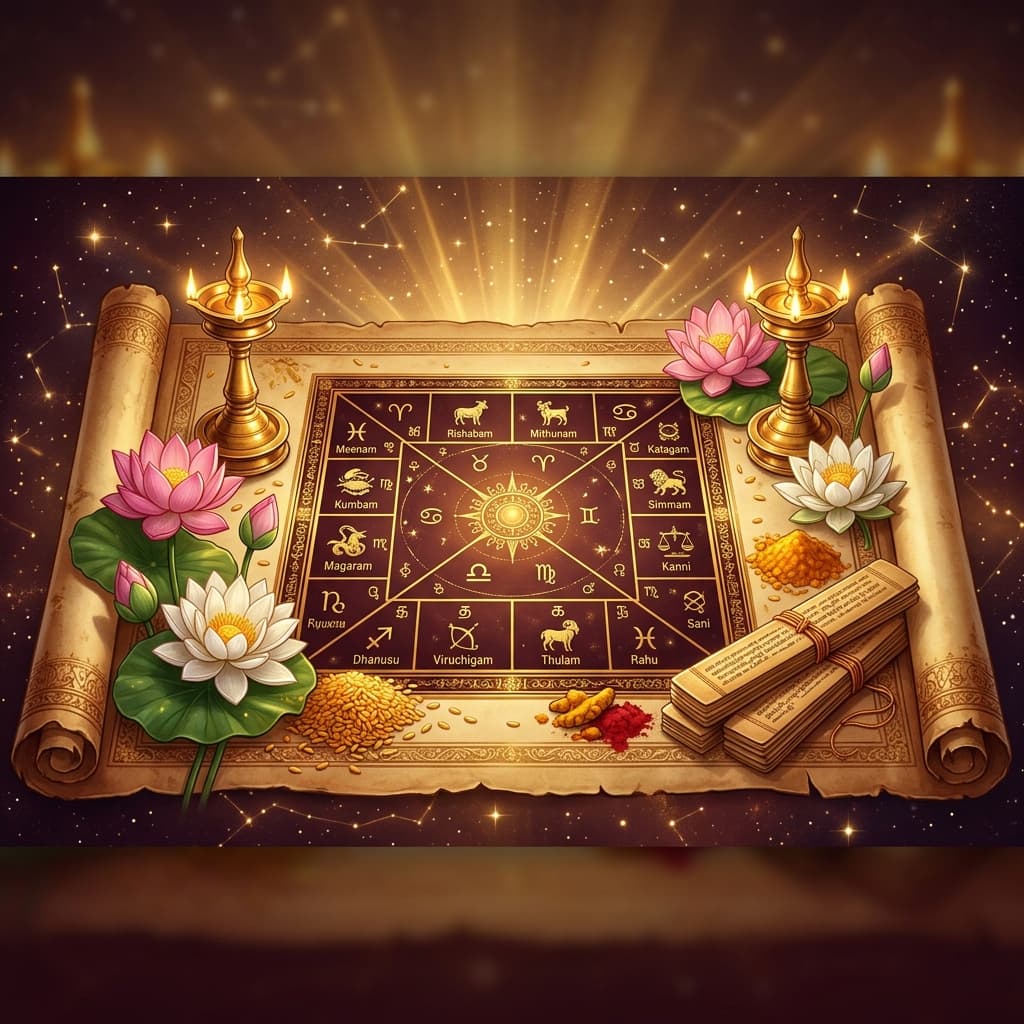
Then comes the Navamsha - the D9 divisional chart - which many people have never even heard mentioned by name, despite it being arguably more predictive of marital outcome than the main Rasi chart. A planet that looks unremarkable in the birth chart can turn out to be exalted or "Vargottama" (repeating its main-chart sign) in the D9, which quietly strengthens the marriage prospects in ways the porutham count never captures.
So when an astrologer finally gives their verdict, it's rarely a pure reflection of the ten-point tally. It's the tally, filtered through Papasamayam balance, checked against Dasa timing, and confirmed - or occasionally overruled - by what the 7th house and Navamsha are quietly saying underneath it all. That's the real five-stage sequence, and it's worth insisting on it rather than settling for a single printed number.