இலவச திருமண பொருத்தம்
Ask any elder in a Tamil family what worries them most about a horoscope, and porutham usually isn't the first word out of their mouth. Dosham is. There's a reason for that. Porutham tells you whether two charts get along. Dosham is something else — a flaw sitting inside one person's own chart, put there by where the planets happened to be at the moment they were born. It doesn't care whether marriage is even part of the conversation yet.
Guide Directory
- Why families care about Doshams
- How to check if you have a Dosham
- Chevvai Dosham (Mars) Guide
- Rahu-Kethu Dosham Guide
- Sarpa Dosham Guide
- Pitru Dosham Guide
- Guru Chandala Dosham Guide
- Kala Sarpa Dosham Guide
- Shani Dosham & Sade Sati Guide
- Grahana Dosham Guide
- Other Doshams (Nadi)
- Dosham Cancellation & Remedies
- Common Questions & FAQ
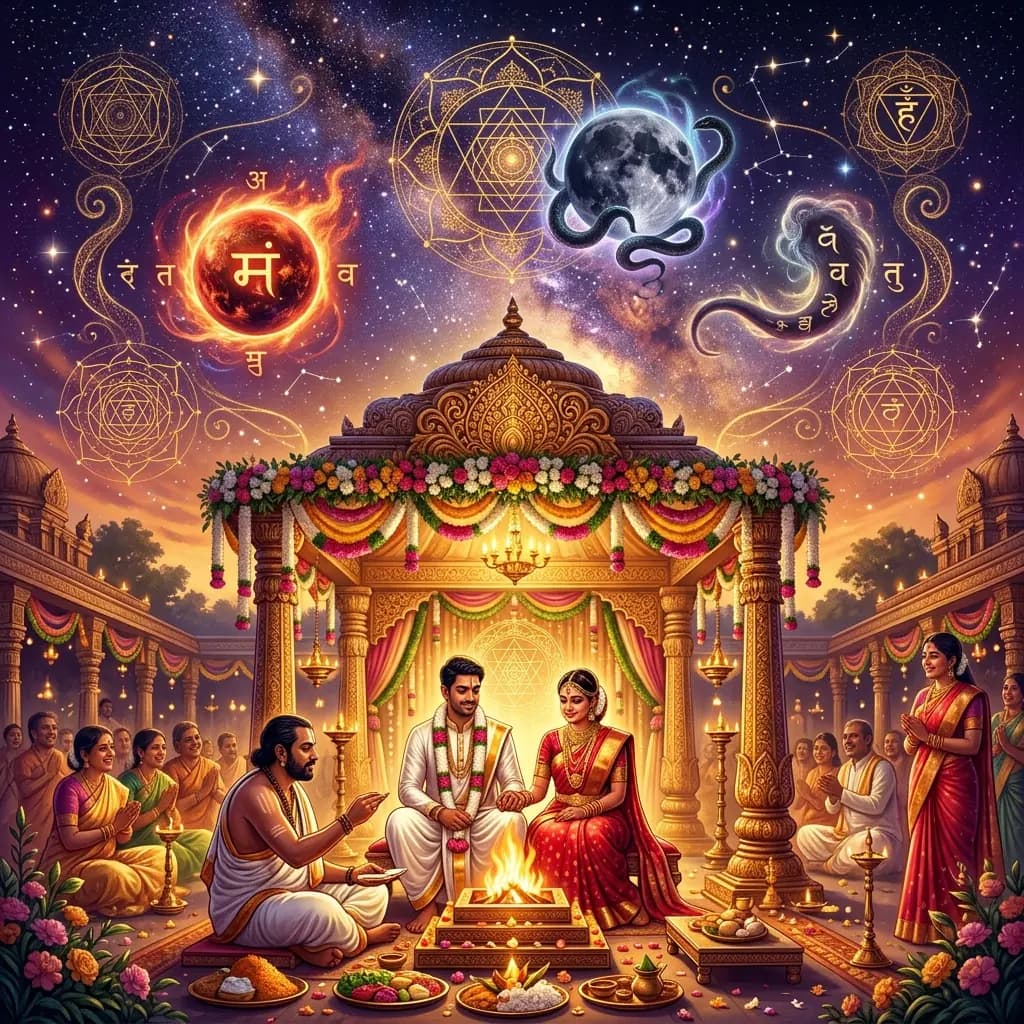
Most people get the two mixed up, which is fair, because they usually come up together. But think of it this way: porutham is a conversation between two horoscopes. Dosham is a fact about one. A chart can carry a dosham whether or not the person ever gets matched with anyone at all — it might show up instead as a stretch of bad luck at work, a health issue that won't resolve, or a wedding date that keeps getting pushed back for no clear reason.
Why families take doshams so seriously before a wedding
Here's what surprises a lot of younger couples: some families will look past a mediocre porutham score, but almost none of them will look past an unaddressed dosham. Ten out of ten poruthams matching means very little to an elder if one side's chart is carrying a serious Chevvai Dosham that hasn't even been discussed. It's treated as the thing that has to be cleared first, not an afterthought tacked on after the star-matching is done. If you want to check your compatibility score, read our complete Thirumana Porutham Guide or evaluate the 10 Poruthams directly.
And it doesn't stop at "does the dosham exist." The next question is always "how bad is it, and does it cancel out." Astrology actually has fairly detailed answers for this — certain doshams neutralize each other when both partners happen to carry a similar one. It's the kind of nuance a five-minute online quiz never gets into, and honestly it's where half the real work of a proper reading happens.
How do you actually know if you have a dosham?
This is the question that brings most people to a page like this one, so let's be direct about it. A dosham isn't something you feel — it's something you read off a birth chart, specifically the placement of certain planets in specific houses relative to the Lagna (ascendant) or the Moon sign. You can't tell by symptoms alone, no matter how many "signs of Chevvai Dosham" lists are floating around online. What you actually need is your date, time, and place of birth run through a proper chart, then checked house by house for the combinations below. A rough self-check from memory is a starting point at best — the real answer comes from someone (or some tool) actually generating your chart and reading the house positions.
The doshams that come up again and again
Chevvai Dosham (Mars Affliction)
Chevvai Dosham, also called Mangal Dosham or Kuja Dosham, is the one everyone's heard of. It forms when Mars sits in the 1st, 2nd, 4th, 7th, 8th, or 12th house counted from either the Lagna or the Moon. Depending on which of those houses Mars occupies, and how strong or weak Mars is in the chart otherwise, the dosham is graded from mild to severe. Families usually ask two follow-up questions here: does it fade with age, and can it be cancelled. On the first — yes, traditional belief holds that Chevvai Dosham's intensity reduces significantly after age 28, which is one reason some families deliberately wait before fixing certain marriages. On the second — cancellation (Kuja Dosha Bhanga) happens through a number of well-documented combinations, including when both partners carry a similar dosham, or when Mars is placed in its own sign or an exalted sign. It's genuinely one of the most misunderstood doshams because people hear "Mars dosham" and assume disaster, when in reality a huge share of horoscopes carry some version of it and go on to have completely normal marriages. Our Chevvai Dosham walks through the exact house-by-house rules and cancellation conditions.
Rahu-Kethu Dosham (Shadow Nodes)
Rahu-Kethu Dosham comes from a different source entirely. Rahu and Kethu aren't physical planets — they're shadow points, the lunar nodes — but they carry serious weight in Tamil astrology precisely because they represent unfinished business, obsession, and confusion rather than a clean, predictable influence the way a real planet does. This dosham gets flagged when Rahu or Kethu sit in sensitive houses (commonly the 1st, 5th, 7th, or 8th) or when they hem in other planets between them, which some astrologers separately classify as Kala Sarpa Dosham — a more intense variant. People searching for this dosham usually want to know why plans keep falling through at the last minute, or why a wedding date that seemed finalized suddenly falls apart. Remedies tend to center on specific poojas for Rahu and Kethu, along with fasting on Saturdays or Wednesdays depending on which node is causing the trouble. Full house placements and remedy options are on the Rahu-Kethu Dosham .
Sarpa Dosham (Serpent Karma)
Sarpa Dosham is tied to serpent energy in the chart, most often linked to Rahu-Kethu afflicting the 5th house (children, progeny) or casting a shadow over the Sun or Moon. In our experience, this is the dosham families ask about most when there's been difficulty conceiving, repeated miscarriage worries, or disputes inside the extended family that just won't die down no matter how they're addressed. It's also the dosham with the most visible remedy tradition — entire temples in Tamil Nadu (Rahu-Kethu sarpa dosha temples in particular) exist specifically to perform Sarpa Dosha Nivarana poojas, and families will often travel a fair distance specifically for this one ritual rather than treat it as a routine fix. Full detail is on the Sarpa Dosham .
Pitru Dosham (Ancestor Obligations)
Pitru Dosham is about unresolved obligations to ancestors, usually tied to the Sun or 9th house being afflicted. It is treated more as a family-wide matter than an individual one, often addressed through Tharpanam rituals on Amavasya days rather than individual temple poojas. If you notice repeated career delays, health issues in paternal relations, or obstacles in family progression, it is traditionally advised to inspect this placement. Full detail and remedies are on our Pitru Dosham .
Guru Chandala Dosham (Jupiter Affliction)
Guru Chandala Dosham is formed when Jupiter (Guru) is conjoined with Rahu or Kethu in a single house. Jupiter represents wisdom, judgment, and clear path guidance. When shadow nodes eclipse it, decisions on career and marriage can get repeatedly clouded, resulting in bad timing or poor judgment. Detailed rules, symptoms, and remedies are on our Guru Chandala Dosham .
Kala Sarpa Dosham (Time Serpent)
Kala Sarpa Dosham is a unique planetary setup where all seven active planets are hemmed in on one side of the chart between the head (Rahu) and tail (Ketu) of the celestial serpent. This structure represents sudden turns of fortune, obstacles in early life, and ultimate growth. Full house variants and remedies are detailed on our Kala Sarpa Dosham .
Shani Dosham & Sade Sati (Saturn Transit)
Unlike birth chart doshams, Shani Dosham & Sade Sati (seven and a half years of Saturn transit) are temporary astrological phases. Saturn teaches discipline, responsibility, and perseverance by introducing delays and challenges. Traditional remedies include Saturday prayers, oil lamp lighting, and charity. Detailed transit rules, symptoms, and remedies are on our Shani Dosham & Sade Sati .
Grahana Dosham (Eclipse Conjunction)
Grahana Dosham forms in a birth chart when the Sun (Surya) or Moon (Chandra) is conjoined directly with Rahu or Kethu. This represents a temporary shadowing of solar or lunar light. Surya Grahana Dosham impacts confidence and fatherly relations, while Chandra Grahana Dosham influences emotional peace and motherly connections. Detailed symptoms and remedies are on our Grahana Dosham .
Other Doshams Worth Knowing
One other worth knowing is Nadi Dosham, which is technically a mismatch on the Nadi match criteria (one of the 10 classic matching items), but is treated almost like a standalone dosham because families consider it a major reason to hold off a marriage match.
A dosham isn't a sentence
This part gets lost way too often. Having a dosham on paper is a flag, not a verdict. Astrologers have spent generations working out what cancels what — dosha nivarana, dosha parihara, whatever term your family uses for it — and it's entirely possible to have Chevvai Dosham technically present while three or four other placements in the same chart cancel it out completely. That's exactly why a proper reading looks at the whole chart together instead of stopping the moment one flagged placement shows up.
Checking before the horoscopes get exchanged
If your family is at the stage where things are getting serious, it's worth checking for dosham alongside your porutham result — and doing it early, before horoscopes go out to the other side. Saves an uncomfortable conversation down the line. Each page linked above walks through how that specific dosham forms, which houses and planets to look for in your own chart, and what remedies are generally accepted for it.
Marriage matching was never meant to begin and end with a ten-point porutham checklist. The fuller picture — poruthams, doshams, and the remedies that bridge whatever gap is left between the two — is what actually gives a family confidence before they commit to a date.